What Is the OEUK Medical Examination?
The OEUK Medical Examination is a medical examination, officially referred to as the Offshore Energies UK Medical Examination, which is a standardised health examination used in personnel involved in the offshore oil, gas and energy industry. Under the control of rules that are established by the Offshore Energies UK (formerly UKOOA), this test assures that all people operating in offshore settings have high medical fitness standards that would enable them to work safely and efficiently.
An offshore workplace has physical and psychological conditions: extreme weather, space restrictions, noise, physically demanding work, and the necessity of emergency response. OEUK Medical Examination is a protective measure – it safeguards the individual worker and his or her fellow crewmembers by ensuring that medical conditions do not impair their security at sea or on a platform.
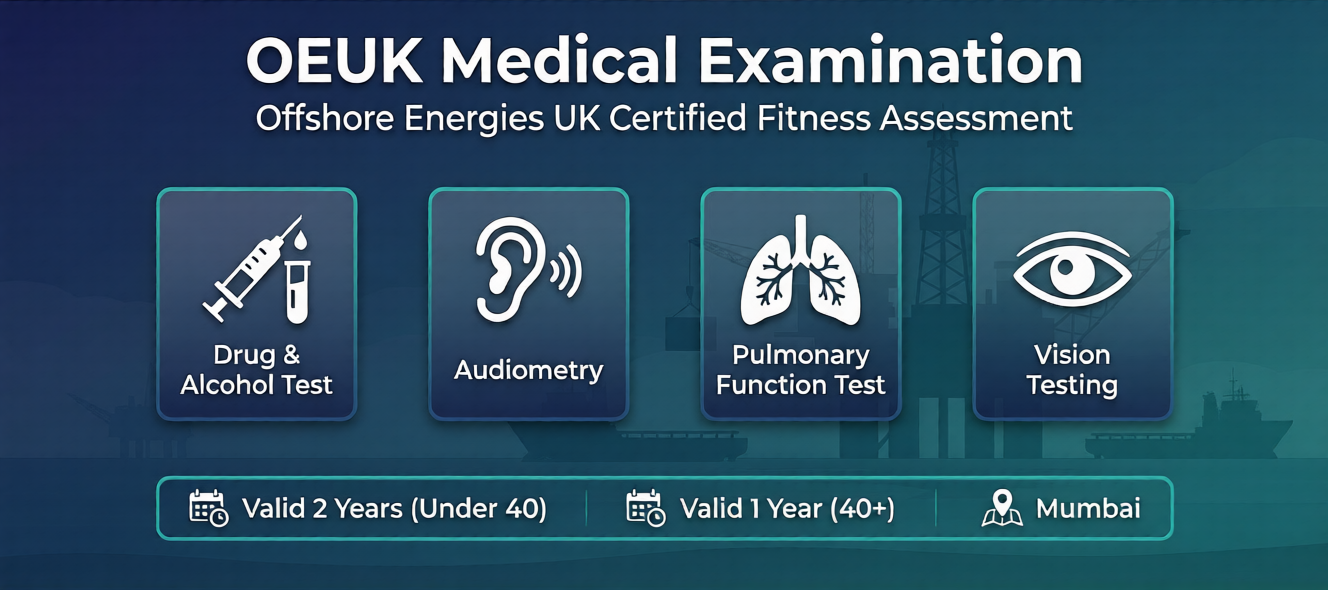
It is a mandatory testing to be conducted prior to the initial deployment and also to be periodically renewed such as every two years in workers who have not attained the age of 40 years and annually in workers who have attained the age of 40 years. The entire evaluation includes four fundamental aspects:
- Drug & Alcohol Test
- Audiometry (Hearing Test)
- Pulmonary Function Test (PFT)
- Vision Testing
All these elements focus on particular areas of occupational health, with all of them benefiting the overall goal of ensuring that the offshore workers are fit-to-duty, healthy, and able to respond to emergent situations when necessary.
Why Does the OEUK Medical Examination Have to Be Mandatory?
Offshore energy industry is also regulated by tight regulations on safety, both on national basis (especially under the UK Health and Safety legislation) and by the industry organisations like the Offshore Energies UK. The OEUK Medical Examination is a prerequisite at least due to several important reasons:
- Fitness for Duty: The offshore work requires long periods of physical ability, keen sense awareness and mental acuity. A physical and mental examination is done to establish that employees are physically and mentally fit to work in their positions.
- Mitigation of Risk: When it is not detected that health conditions are undetected or substance impaired, then it results in catastrophic accidents in remote high risk environments. This risk is minimised through regular medical check-ups.
- Regulatory Compliance: There is a legal care of duty on the part of the operators and contractors. The presence of the valid OEUK Medical Certificate among all the personnel will save the companies the risk of violating regulations and being liable.
- Emergency Readiness: During an offshore emergency fire, evacuation, medical incident, all persons onboard should be physically prepared to respond. This is confirmed by the OEUK Medical Examination.
- Insurance & Liability: The offshore insurance policies as well as the contractor agreements usually require a legit OEUK Medical Certificate.
Eduforce has its office in Mumbai, India, and it is offering OEUK Medical Examination services to offshore employees who want to be certified before international assignments. Eduforce has a clinical staff with experience in occupational health and offshore fitness standards, which means that every candidate will be assessed according to the standards and properly documented.
The Four Fundamental Interpreters of the OEUK Medical Examination.
The OEUK Medical Examination has been organized to include four fundamental health examinations. The breakdown of each component is presented below, including what each entails, what each measures and why it is important to offshore safety.
1. Drug & Alcohol Test
Drug & Alcohol Test is regarded as one of the most significant aspects of the OEUK Medical Examination. The fact that substance impairment in an offshore environment is an extreme danger is not to the individual only, but also to whole crews and installations.
What Does It Involve? The OEUK Medical Examination Drug & Alcohol Test usually involves a urine screen that is a panel of controlled substances and a breath or blood alcohol test. Common drug screening includes:
- Cannabis (THC)
- Cocaine and its metabolites
- Opiates (heroin and morphine)
- Amphetamines and Methamphetamines.
- Benzodiazepines
- Methadone
- Barbiturates
The tests of alcohol are required to ensure blood alcohol level is under the legally and industrially fixed legal level that, in most offshore settings is zero tolerance.
Why It Matters: The offshore environment is merciless. Marty suffers even a minor impairment even in performing a hazardous task like drilling, crane lifts, or emergency drills. The Drug & Alcohol Test that is integrated with the OEUK Medical Examination allows a drug-free and alcohol-free workforce on all of the installations.
Consequence: Failed Drug & Alcohol Test will lead to the withholding of the OEUK Medical Certificate until the candidate can prove sobriety over an extended period (and by treatment where necessary a rehabilitation or counselling programme).
2. Audiometry (Hearing Test)
Audiometry refers to the medical test of the hearing capacity of an individual. In the OEUK Medical Examination, audiometry test will evaluate an individual whether he/she is able to hear in the range that will allow him or her to engage in safe offshore work.
What Does It Involve? In the audiometry part of the OEUK Medical Examination, the candidate is placed in a soundproofed room and is fitted with headphones that are linked up to an audiometer. Pure-tone audiometry is used to test the sensitivity to hearing at various frequencies – low tones (250 Hz) and high tones (8,000 Hz). These outcomes are represented on a graph of audiogram.
What Is Being Assessed? The audiometry test of the OEUK Medical Examination identifies the possibility of the candidate to hear warning signals, verbal messages, and alarms at acceptable decibel levels. The prime benchmarks are established based on the OEUK guidelines..
Why It Matters: Offshore environments are high ambient noise environments, i.e., machinery, generators, wind, and sea. Employees should be in a position to speak clearly and answer auditory alert. Even severe hearing impairment can help disqualify an applicant to some offshore jobs or force him or her to use hearing protection aids.
Occupational Noise and the OEUK Standard: Any regular audiometric testing is effective in monitoring changes in hearing among workers over time, and allow early prevention of workers who display indicators of noise-induced hearing loss – a frequent occupational risk in the offshore business.
3. Pulmonary Function Test (PFT)
Pulmonary Function Test also referred to as spirometry is a mandatory part of the OEUK Medical Examination. It assesses the functioning of the lungs of the candidate and whether or not there exists a respiratory limitation that can harm the offshore responsibilities of the candidate.
What Does It Involve? This is done in the PFT stage of the OEUK Medical Examination whereby the candidate breathes into a spirometer device. Key measurements include:
| Measurement | Description |
| FVC (Forced Vital Capacity) | Full amount of the air which is exhaled forcefully upon a complete inhalation. |
| FEV1 (Forced Expiratory Volume in 1 sec) | Volume of air expired in first second – important measurement of obstruction of airways. |
| FEV1/FVC Ratio | Ratio employed to tell the difference between an obstructive and restrictive lung disease. |
| Peak Expiratory Flow (PEF) | Maximum rate of exhalation in a forced expiratory discharge – is a measure of effort and airway health. |
Why It Matters: Respiratory hazards such as chemical fumes, gases, dust, etc. may be experienced by the offshore workers. The PFT element of the OEUK Medical Examination, is done to ensure that the lung function of a candidate is adequate to withstand such exposures and that pre-existing conditions like asthma, COPD or other restrictive lung diseases would not be hazardously worsened.
Moreover, there is a risk of emergency circumstances that will demand workers to wear self-contained breathing apparatus (SCBA) or escape respiratory protective equipment (RPE). The PFT assures them that they are physically fit to do it safely when physiologically stressed.
Preparation Tip: It is a good idea that the candidates should not engage in any strenuous exercise, smoke, and eat heavy meals within the few hours before the PFT. Inhalers Bronchodilators can be allowed but must be reported during the OEUK Medical Examination.
4. Vision Testing
The fourth critical part of OEUK Medical Examination is the vision testing. It determines the eyesight of a candidate as to whether they can safely work in offshore.
What Does It Involve? The vision testing item of the OEUK Medical Examination usually comprises:
- Visual Acuity Test: This is a test that determines the sharpness of both near and distant vision, and is typically done on a Snellen chart. The acceptable standard of offshore work is normally 6/12 or above in the better eye with or without the use of corrective lenses.
- Colour Vision Assessment: This is especially relevant in the jobs that require colour coded wiring, safety signals or reading instrument panel. Ishihara plates or the likes are employed.
- Visual Field Test: Tests the peripheral vision impairments that might be dangerous in dynamic work station.
- Intraocular Pressure (where necessary): Could be measured at the site where the risk of glaucoma is reported.
- Corrective Lenses: Candidates should also bring their prescription glasses or contact lenses to OEUK Medical Examination because the vision is tested with and without them. The fixed vision should be at the standards set.
Why It Matters: Vision is not compromised in an offshore setting. The employees should be able to read tools, detect hazards remotely, walk in the poor weather on walkways and to recognise safety signs. Interfered vision (corrected or not) of sub-OEUK standards may disqualify one to be issued with his OEUK Medical Certificate.
OEUK Medical Examination Health Assessments.
In addition to the four main elements, OEUK Medical Examination also provides the wider clinical examination as the measure of the fitness to deploy to offshore areas. Additional examinations are possible depending on the investigation of the examining physician and medical history of the candidate such as:
- Heart and blood pressure examination.
- Body Mass Index (BMI) and musculoskeletal examination.
- Check-up of the existing medications and their appropriateness to offshore work.
- Kidney functioning urinalysis, glucose, and protein.
- Electrocardiogram (ECG) of candidates who are above specific age or who have risk factors associated with cardiovascular diseases.
- Psychological fitness and Mental Health.
These additional tests indicate how the OEUK Medical Examination is holistic. Offshore fitness is not the lack of acute disease it includes cardiotic strength, musculoskeletal ability, mental health and compatibility with medication and offshore lifestyle.
OEUK Medical Certificate: Renewal and validity.
When an individual passes the OEUK Medical Examination, he or she is awarded an OEUK Medical Certificate that is accepted in UK North Sea operations and most offshore installations in other regions. The certificate has several important facts such as:
| Detail | Information |
| Validity -Less than 40 Years | 2 years since examination date |
| Validity 40 Years | Above 1 year after examination date. |
| Format | Standardised OEUK Medical Certificate that has been issued by a licensed physician. |
| Recognised By | OEUK member companies: North Sea operators, international offshore operators. |
| Renewal | The process should be done prior to the expiry of the current certificate. |
| Failure Outcome | Outcome Withholding of certificate; retaking after medical problems are resolved. |
Both the employee and his/her employer have the role of ensuring that the OEUK Medical Certificate remains updated. Hiring the staff having an expired certificate is a severe violation of the regulations.
Preparation in the OEUK Medical Examination.
Proper preparation helps to enhance the level of accuracy in the results and facilitates the examination process. The following steps can be considered by candidates who are next to OEUK Medical Examination:
- Bring all prescribed drugs and records.
- Carry vision testing component: corrective lenses, glasses or contacts.
- Stop drinking at least 48 hours prior to Drug & Alcohol Test.
- Do not subject oneself to vigorous activities and smoking within hours before the PFT.
- Bring a list of pre-existing medical conditions and surgery.
- Hearing protection should be regular in the case of working in a noisy environment, sudden acute trauma preceding audiometry may influence outcomes.
- Carry government-identified statements and any previous prior OEUK Medical Certificates.
At Eduforce, a pre-examination checklist and a point-of-contact is offered to candidates with any questions before they come. This makes sure that the OEUK Medical Examination is run efficiently and without invalid results.
Who Requires an OEUK Medical Examination?
Examination of OEUK in medicine is mandatory to a wide array of offshore workers, which are not just platform workers. Any person travelling offshore even in a temporary visit basis might need a valid OEUK Medical Certificate. This includes:
- Drilling and production crew.
- Offshore technicians and engineers.
- Sea personnel in ships servicing offshore.
- Both divers and diving bosses.
- Offshore catering and hospitality employees.
- HSE officers and safety personnel.
- Auditors, surveyors and inspectors.
- LSC and logistics staff having offshore access.
With this wide scope of positions addressed, the OEUK Medical Examination is considered to be one of the most popular occupational health qualifications in the offshore energy sector worldwide.
Eduforce: Your Reliable OEUK Medical analysis in India.
Eduforce is an occupation health and safety training provider with vast experience in providing support to the offshore workforce in the energy industry with its headquarters in Mumbai, India. OEUK Medical Examinations administered by our medical staff are held in a professional, confidential, and clinically rigorous setting – so that each and every candidate is accorded a precise fitness evaluation according to the current OEUK procedures.
What is the reason to use Eduforce as your OEUK medical exam?
- Skilled occupational health doctors conversant with OEUK standards.
- State of the art audiometry, PFT, vision testing as well as Drug and Alcohol Test equipment.
- Quick response on OEUK Medical Certificates.
- During the handling of all medical records, confidentiality is maintained.
- In-depth pre-examination counseling to the candidates.
- In Mumbai and conveniently situated with flexible booking.
Eduforce is a one-stop supplier of the OEUK Medical Examination process to support first-time offshore workers and renewing an existing certificate.
Contact Eduforce
| Eduforce 508, 5th Floor, Avior Corporate Park, Opp. LBS Marg,
Mulund (W), Mumbai Suburban, Maharashtra 400080, India Phone: +91 7498845222 | +91 7498845333 E-mail: dr.mona@eduforce.in | asha@eduforce.in Website: www.firstaidtraining.in |
FAQs — OEUK Medical Examination.
Q: How many minutes does OEUK Medical Examination take?
A: The entire OEUK Medical Examination -( Drug and alcohol test, audiometry, PFT and the vision test, and the general clinical evaluation) is usually 60 to 90 minutes, based on the medical history of the candidate and/or any other test necessary.
Q: Will I be allowed to work offshore with a failed Drug and Alcohol Test?
A: No. Fail on Drug and Alcohol Test implies the non-issuance of the OEUK Medical Certificate. The candidate has to discuss the substance related issue and only after that, he can retake the examination.
Q: What is going to happen in case I fail in the audiometry test?
A: In case the audiometry results are below the accepted standards, the physician examining the patient will record the level of hearing loss. In other instances, hearing aids can be retested and prescribed. Other offshore jobs could be limited by serious hearing impairment.
Q: Vision testing: allowed with glasses or contact lenses?
A: Yes. Sight is examined with or without correctives. Glasses or contacts are more than welcome as long as the corrected vision is within the OEUK standard (usually 6/12 or higher in the better eye).
Q: How frequently should the OEUK Medical Examination be renewed?
A: Candidates below the age of 40 are to be renewed at least after every two years. Individuals whose age is 40 and above are required to renew every year. The worker and the employer have the duty of keeping the certificate valid.
Q: Does the OEUK Medical Examination consist of standard offshore medical?
A: The OEUK Medical Examination is in accordance with the particular guidelines published under the Offshore Energies UK and is the standard within the industry of the UK North Sea operations. Although it has similar elements with the general offshore medics, it should be carried out by an OEUK certified physician to be legal (as far as North Sea and other deployments are concerned).
Conclusion
OEUK Medical Examination is much more than a control box; it is a multi-layered health assessment program that protects offshore workers, their peers, and the health of the energy business operations in the world. Including a Drug and Alcohol Test, Audiometry, Pulmonary Function Test (PFT) and Vision Testing, the assessment will make sure that all people sent out to the sea are fully fit to deal with all the physical, sensory and physiological challenges of the job.
To employees and employers in India who both trust and require professionally administered OEUK Medical Examination of professional caliber, Eduforce in Mumbai has the expertise in clinics, certified equipment, and the expertise in the industry to provide the required quality and accuracy in the process.
Request your OEUK Medical Examination through Eduforce today and start the offshore certified career with a safe step.